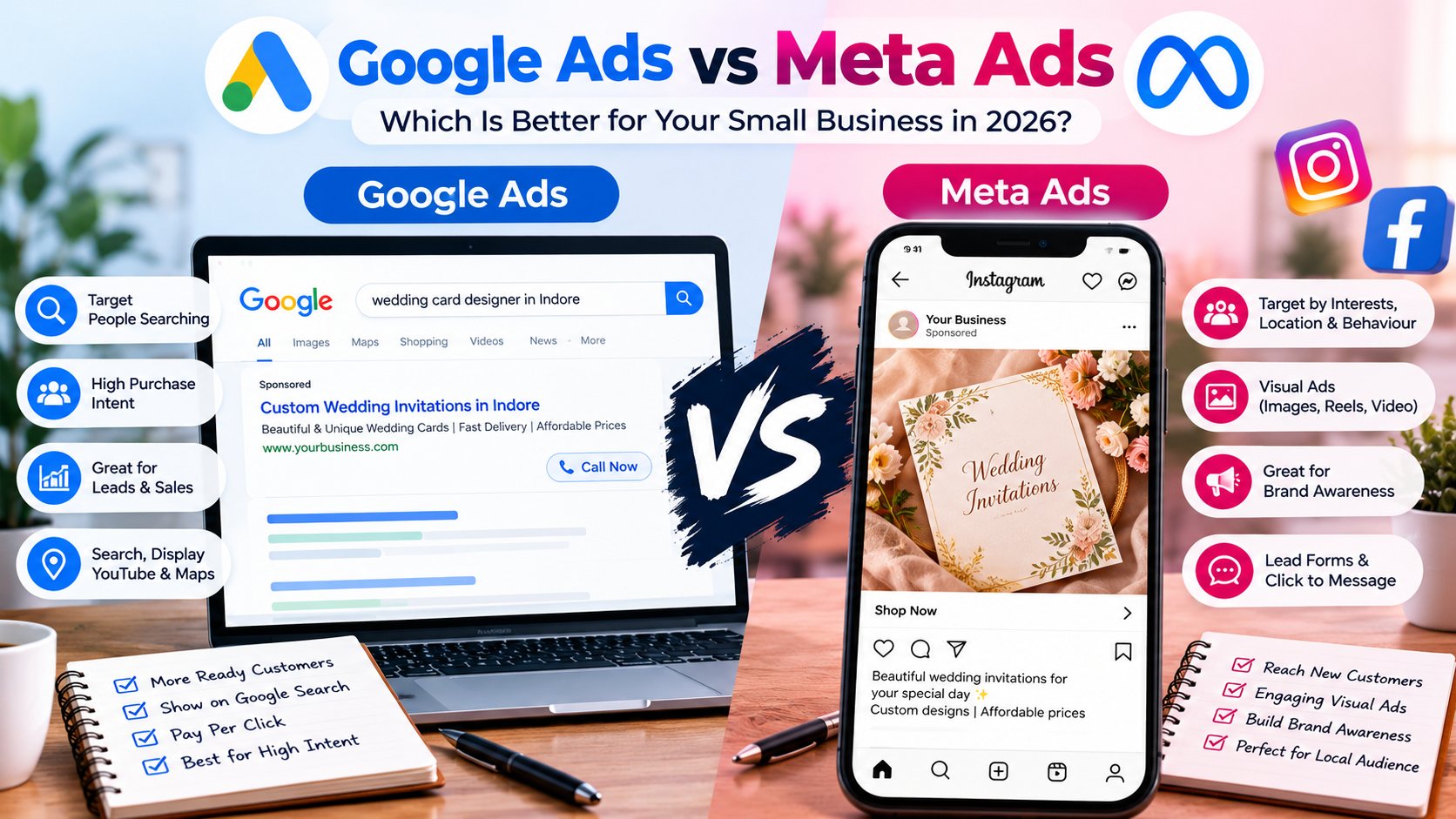
You have decided to run ads, and now you are stuck at the first big question: Google Ads or Meta Ads (Facebook and Instagram)?
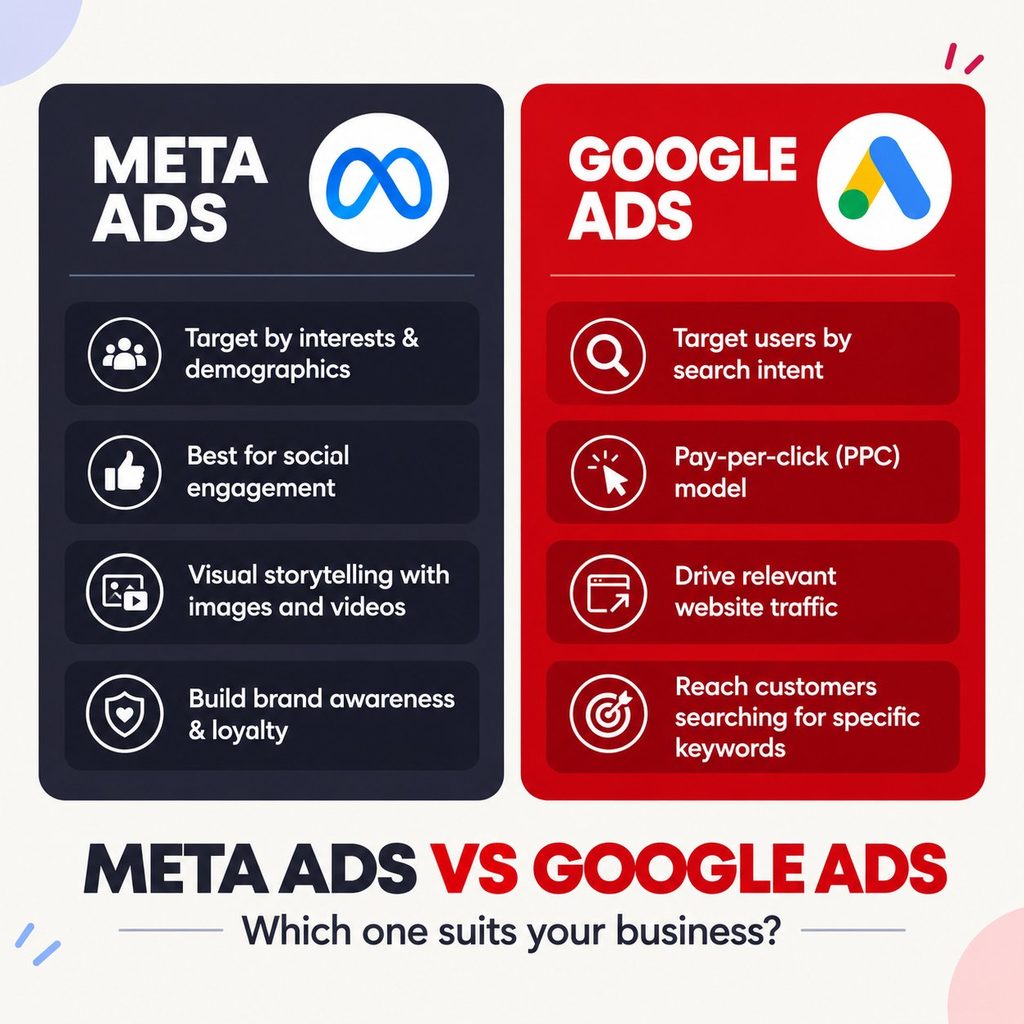
Google Ads vs Meta Ads is the first big question almost every small business owner faces once they decide to run ads. Ask five people and you will get five different answers.
Here is the honest one: the two platforms work in different ways, and the better choice depends on what you sell and who your customer is. In this Google Ads vs Meta Ads guide, we compare intent, cost, targeting, and results, so you can pick the right one for your business
What Is Google Ads?
Google Ads lets you show your business to people while they are searching on Google. You can create an account for free on the official Google Ads website and learn the basics in the Google Ads Help Center.The main formats are:
- Search ads: text ads that appear above or below the results when someone searches a keyword
- Display ads: banner ads on websites in Google’s network
- YouTube ads: video ads on YouTube
- Maps and local ads: ads that help nearby customers find you
For example, if someone searches “wedding card designer in Indore,” your ad can appear right at the top. You usually pay when someone clicks (this is called PPC, or pay-per-click). See our Google Ads & PPC service.
What Is Meta Ads?
Meta Ads lets you show your business to people on Facebook, Instagram, and Messenger. You manage everything through Meta Ads Manager, and you can schedule posts and check messages in Meta Business Suite.The main formats are:
- Image and carousel ads
- Reels and video ads
- Story ads
- Lead form ads (people share details without leaving the app)
- Click-to-message ads (opens a chat with you)
Here, people are not searching for you. They are scrolling, and your ad appears in front of them. See our Meta Ads service.
The Core Difference: Intent
This is the most important idea in the whole article.
- Google Ads captures existing demand. The person is already searching for what you sell.
- Meta Ads creates demand. The person was not looking, but your ad catches their interest.
Think of it this way: Google is like a shop on a busy market street where people walk in because they need something. Meta is like a stall at a fair where you attract people who were just passing by.
Neither is better by default. They solve different problems.
Google Ads vs Meta Ads: Head-to-Head Comparison
| Factor | Google Ads | Meta Ads (Facebook and Instagram) |
|---|---|---|
| Customer mindset | Searching, ready to act | Scrolling, discovering |
| Best for | Services people urgently need | Products and brands that look good or inspire |
| Ad format | Mostly text (plus video and display) | Mostly visual (images, reels, video) |
| Targeting based on | Keywords and search behaviour | Interests, age, location, behaviour |
| Speed of leads | Often quick, if people are searching | Quick to start, but needs good creatives |
| Creative work needed | Less (good copy matters most) | More (visuals decide success) |
| Brand awareness | Moderate | Strong |
| Learning curve | Keyword and bidding concepts | Audience and creative testing |
1. Cost
Neither platform has a fixed price. In both, you set your own budget, and the cost depends on your industry, competition, location, and ad quality. Google keywords for high-value services (like loans or legal help) can be expensive, while Meta can often reach a wide local audience at a lower cost per click. But a cheaper click does not always mean a cheaper customer. What matters is your cost per lead and cost per sale.
A sensible way to start for most small businesses is a small test budget, such as the ₹300 to ₹500 per day mentioned in our beginner guide, for one or two weeks. [LINK: Google Ads budget blog]
2. Targeting
Google Ads targets what people type. You choose keywords like “AC repair Indore” and your ad appears when someone searches for it. You can also target locations, timings, and devices.
Meta Ads targets who people are. You can choose women aged 22 to 35 within 10 km of your shop who are interested in weddings or fashion. You can also show ads to people who already visited your website or followed your page (called retargeting).
3. Creative Needs
On Google Search, your ad is mostly text, so clear headlines and a strong offer matter most. On Meta, your visual does the heavy lifting. A scroll-stopping image or reel makes the difference between getting ignored and getting enquiries. If you need professional ad creatives, our social media creatives service can help.
4. Tracking and Results
Both platforms give detailed reports on impressions, clicks, click-through rate, and cost per lead. To track real enquiries and not just clicks, set up conversion tracking (for example, form submissions, calls, or WhatsApp clicks). Without tracking, you can easily spend money without knowing what worked.To track real enquiries and not just clicks, connect your website with Google Analytics and set up conversion tracking on both platforms.
Which One Should You Choose? A Simple Guide
Choose Google Ads if:
- People already search for your service (plumber, dentist, tutor, web designer, CA)
- You want enquiries quickly from ready-to-buy customers
- Your service is urgent or high-intent
- You have a website or landing page that is ready
Choose Meta Ads if:
- Your product is visual (fashion, food, jewellery, decor, e-invites, events)
- You want to build brand awareness in your area
- People don’t search for your product by name yet
- You want to collect leads or messages through Instagram or WhatsApp
- You can make good photos and reels
Use both if:
- You have a steady budget
- You want to catch people who are searching and introduce your brand to new people
- You want to retarget people who already visited your website
Real-Life Style Examples
These are simple illustrations, not guaranteed results.
Example 1: AC repair service in Indore.
Customers usually search when their AC stops working. Google Ads is the better first choice because people are already looking.
Example 2: A boutique launching a new collection.
Customers are not searching for the collection yet. Meta Ads works better because eye-catching reels can introduce it to the right audience.
Example 3: A digital e-invite designer.
People search “wedding e-invite maker” during the wedding season, and they also get inspired by invites they see on Instagram. Here, both together make sense: Google for people searching, Meta to show designs and build trust.
Beginner Mistakes to Avoid on Both
- Running ads without a clear goal (leads, calls, or sales)
- Sending people to a slow or confusing website
- Not setting up tracking
- Targeting too wide an area or audience
- Changing the ads again and again, before the platform has had time to learn
- Judging results after just one or two days
- Ignoring leads, then wondering why ads “don’t work”
- Using the same creative for weeks without testing
What About SEO?
Ads give you fast results, but they stop when your budget stops. SEO takes longer, but it brings free traffic over time. Many businesses use ads for quick leads while building SEO in the background. Learn the basics in our guide on what SEO is and how it works, and if you serve a specific city, read local SEO basics.If you serve a specific city, also set up a free Google Business Profile so people can find you on Google Maps.
A Simple Starter Plan (First 30 Days)
Week 1: Prepare
- Decide one goal (for example, 20 enquiries in a month)
- Make sure your website or WhatsApp number is working
- Set up conversion tracking
Week 2: Launch a small test
- Start one campaign on the platform that suits you best
- Keep the budget low and the targeting focused
Week 3: Watch and learn
- Check which ad, keyword, or audience gives the best leads
- Pause what is not working
Week 4: Improve
- Put a little more budget on what works
- Test one new creative or one new headline
The golden rule is simple: test small, learn fast, and scale only what works.
Final Thoughts
In the Google Ads vs Meta Ads debate, there is no single winner. Google is best when people are searching for you. Meta is best when you want to introduce your business to people who might need it. For many small businesses, starting with one platform and adding the second later is the smartest and safest approach.
Not sure which one fits your business? Creative Nest helps small businesses plan and run Google Ads and Meta Ads, with creatives, landing pages, and tracking. Book a free consultation →
You may also like our comparison of digital marketing vs traditional marketing.
Frequently Asked Questions
Which is better for a small business, Google Ads or Meta Ads?
It depends on your business. Google Ads works well when people already search for your service, and Meta Ads works well for visual products and brand awareness.
Is Google Ads more expensive than Meta Ads?
Not always. Costs depend on your industry, competition, and location. Compare cost per lead, not just cost per click.
Can I run both Google Ads and Meta Ads together?
Yes. Many businesses use Google to catch people who are searching and Meta to reach new people and retarget visitors.
What is the minimum budget for ads?
There is no fixed minimum, and you can set your own daily budget. Many beginners start small and increase only after they see results.
Are Instagram ads part of Meta Ads?
Yes. Facebook, Instagram, and Messenger ads are all managed through Meta’s advertising platform.
Which gives faster results?
Both can start bringing traffic within days. Google often brings ready-to-buy customers faster, while Meta may need more creative testing.
Do I need a website to run ads?
For Google Ads, a website or landing page is strongly recommended. For Meta Ads, you can also use lead forms or click-to-message ads.
Do ads work better than SEO?
They work differently. Ads are faster but stop when you stop paying, while SEO is slower but builds free, long-term traffic.
Leave a Reply