Should you spend ₹20,000 on a newspaper ad and a hoarding, or on Instagram and Google ads? This question comes up in almost every small business, from a bakery in Indore to a coaching class in Ratlam.
The honest answer is that neither wins in every case. In the debate of digital marketing vs traditional marketing, the right choice depends on your customers, your budget, and your goal. This guide compares the two on cost, reach, tracking, and results, so you can pick with confidence.
If you are completely new to online promotion, start with our digital marketing for beginners guide and then come back here.
What Is Traditional Marketing?
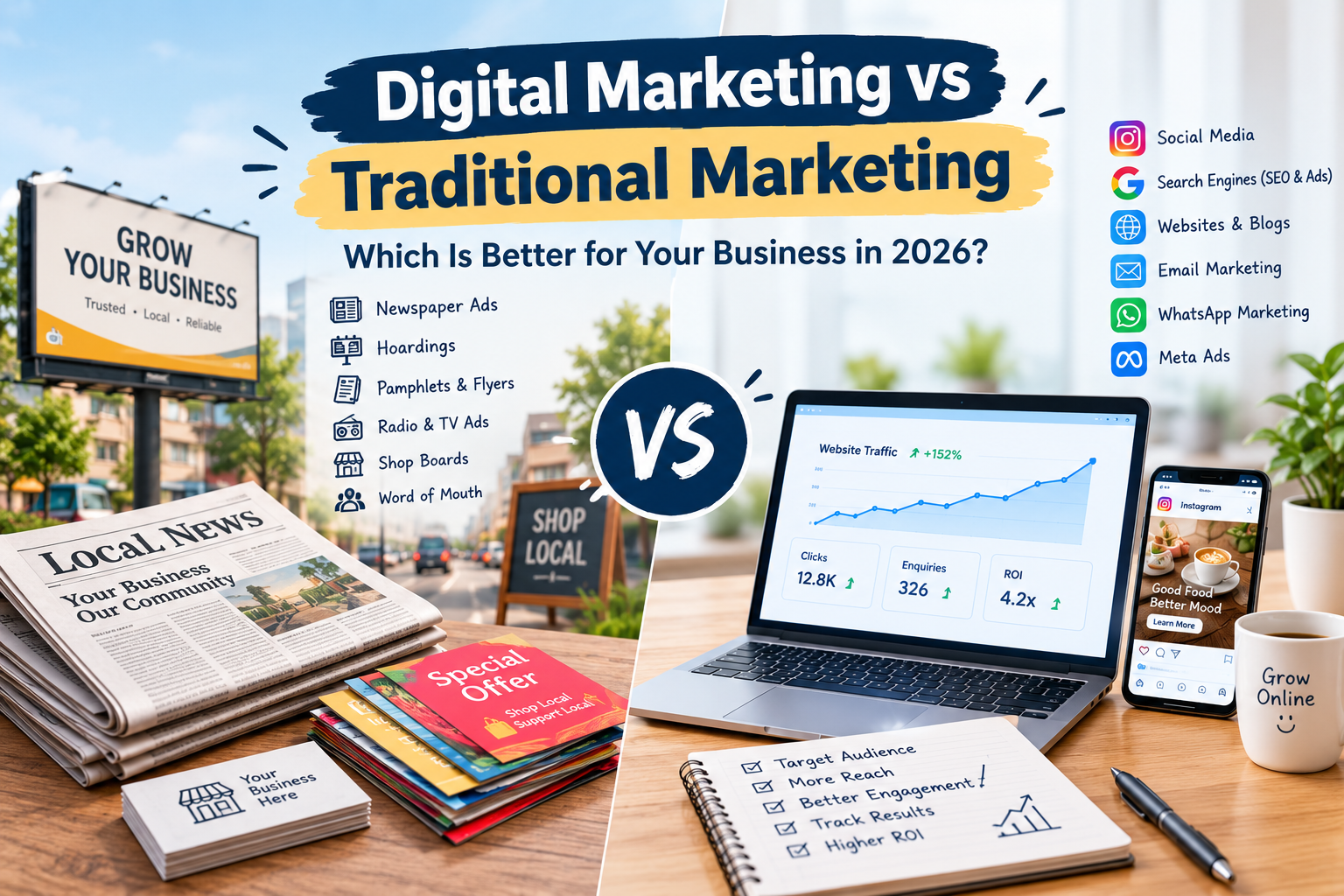
Traditional marketing means promoting your business through offline channels. Common examples:
- Newspaper and magazine ads
- Hoardings, banners, and wall paintings
- Pamphlets and flyers
- Radio and TV ads
- Visiting cards, shop boards, and standees
- Word of mouth and local events
It has worked for decades, and it still works in many places, especially for local businesses with a loyal neighbourhood customer base.
What Is Digital Marketing?
Digital marketing means promoting your business through online channels, such as:
- Social media (Instagram, Facebook, LinkedIn, YouTube)
- Search engines (SEO and Google Ads)
- Websites and blogs
- Email and WhatsApp marketing
- Paid social ads (Meta Ads)
Its biggest strength is that you can target specific people and see exactly what is working.
Digital Marketing vs Traditional Marketing: Head-to-Head Comparison
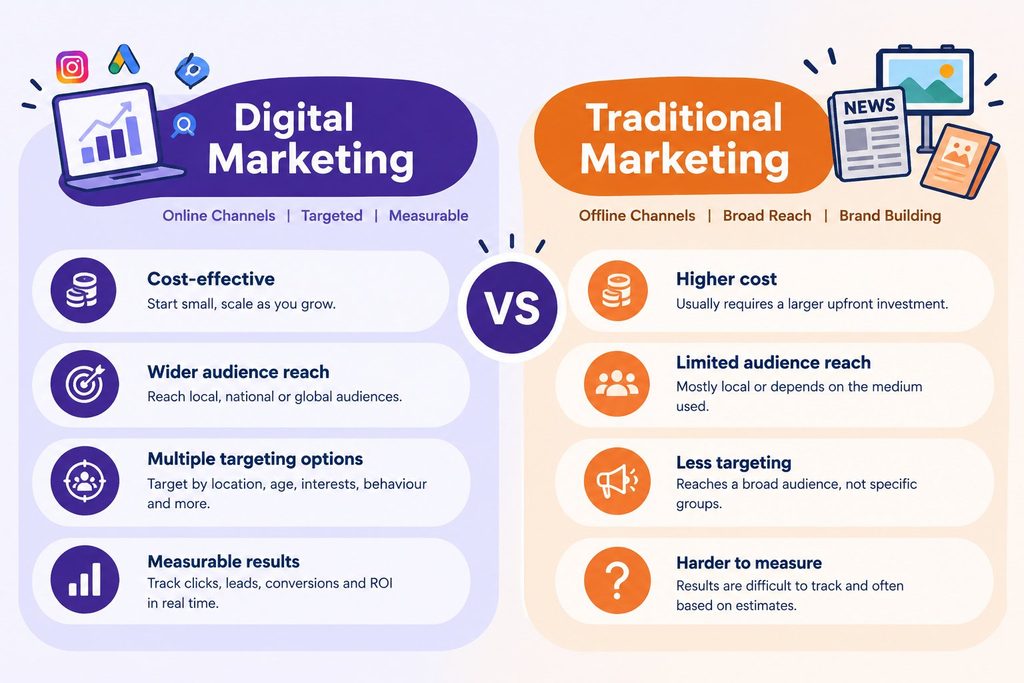
| Factor | Traditional Marketing | Digital Marketing |
|---|---|---|
| Starting cost | Usually high and fixed | Can start small and scale |
| Audience targeting | Broad (everyone who sees it) | Specific (location, age, interests) |
| Tracking results | Very hard | Detailed and real-time |
| Speed of changes | Slow, reprint needed | Instant edits |
| Customer interaction | One-way | Two-way (comments, DMs, calls) |
| Reach | Local or limited by medium | Local to global |
| Trust factor | High for older audiences | High with reviews and social proof |
| Lifespan | Ends when the ad period ends | Content can keep working for months |
Now let’s look at each factor in more detail.
1. Cost
Traditional ads often need a big upfront payment. A newspaper ad or a hoarding is booked for a fixed period, and you pay the full amount whether it brings customers or not. The exact rates vary by city, paper, and location, so always compare quotes.
Digital marketing is more flexible. You can post organically for free, or run ads with a small daily budget (many beginners start with ₹300 to ₹500 per day for a test) and stop or change them any time.
Winner for small budgets: Digital marketing.
2. Targeting
A newspaper ad reaches everyone who reads that page, including people who will never buy from you. With digital ads, you can show your message only to women aged 22 to 35 within 10 km of your shop who are interested in weddings, for example.
Winner: Digital marketing.
3. Tracking and ROI
This is the biggest difference. With a hoarding, you can only guess how many people saw it and how many came because of it. With digital marketing, you can track reach, clicks, enquiries, and cost per lead. Free tools like Google Analytics show where your website visitors come from.
Winner: Digital marketing.
4. Trust and Credibility
Here, traditional marketing still has an edge with some audiences. A shop board, a printed brochure, or a newspaper mention can make a business feel established, especially for older customers who are less active online.
But digital can build trust too, through Google reviews, a professional website, and a consistent Instagram page.
Winner: Tie, depends on your audience.
5. Reach and Local Visibility
If you serve only your neighbourhood, a good board and local word of mouth are powerful. But even then, most people now search on Google Maps before visiting a new place. A complete Google Business Profile puts you in front of people already looking for what you sell. See how we help with local business marketing.
Winner: Digital for discovery, traditional for neighbourhood presence.
A Simple Example: Same Business, Two Approaches
Imagine a new boutique in Indore with a ₹15,000 monthly marketing budget. These numbers are only an illustration, not real results.
Approach A (traditional only): Most of the money goes into a newspaper insert and pamphlets. Customers may see it, but the boutique cannot tell which people came because of it.
Approach B (digital first): Around ₹5,000 goes into Instagram content and creatives, ₹7,000 into Meta ads aimed at women nearby, and ₹3,000 into a Google Business Profile and WhatsApp catalogue. Every week, the owner can see which post or ad brought enquiries and put more money into the best one.
Approach B is not magic. But it gives the owner something Approach A never can: clear data to improve every month.
When Traditional Marketing Still Makes Sense
Do not throw offline marketing away. It works well when:
- Your customers are mostly older and not very active online
- You run a local shop where footfall matters (a board and good signage help)
- You are promoting a local event, opening, or festival sale
- You want to build brand recall in your area
When Digital Marketing Is the Better Choice
Go digital first when:
- You have a limited budget and want to test small
- You sell services, online products, or take bookings and enquiries
- Your audience is young and uses Instagram, YouTube, or WhatsApp daily
- You want to measure what is working
- You want to grow beyond your local area
The Best Strategy for Most Small Businesses: Use Both
In real life, the smartest approach to digital marketing vs traditional marketing is not choosing one. It is connecting them:
- Put your Instagram handle and a QR code on your shop board, pamphlets, and visiting cards.
- Use the same colours, logo, and message offline and online so people recognise you.
- Ask offline customers to leave a Google review or follow your page.
- Use offline events and photos as content for your reels and posts.
Think of offline as the first handshake, and digital as the conversation that continues after it. Not sure how to split your budget? Our consultation can help you plan it.
How to Decide in 5 Steps
- Define your goal. Footfall, enquiries, or brand awareness?
- Know your customer. Where do they spend time, online or offline?
- Set a test budget. Start small, usually 70% digital and 30% offline for most local small businesses, then adjust based on results.
- Track everything. Use a unique phone number, a WhatsApp link, or a “how did you hear about us?” question.
- Review after 30 days. Keep what works, stop what doesn’t.
Common Mistakes to Avoid
- Spending a large amount on one hoarding or one ad without testing
- Choosing digital but posting randomly without a plan
- Running ads without tracking enquiries
- Ignoring offline touchpoints like signage and packaging
- Expecting results overnight from either method
Final Thoughts
In the digital marketing vs traditional marketing debate, digital wins on cost control, targeting, and tracking, while traditional still wins on local trust and presence for some audiences. For most small businesses in India, a digital-first approach supported by simple offline marketing gives the best return.
Start small, track your numbers, and grow what works.
Need help building your digital presence? Creative Nest helps small businesses with Google Ads, Meta Ads, websites, social media creatives, and e-invites. Book a free consultation →
Frequently Asked Questions
What is the main difference between digital marketing and traditional marketing?
Traditional marketing uses offline channels like newspapers, hoardings, and pamphlets, while digital marketing uses online channels like social media, search engines, websites, and email. Digital offers better targeting and tracking.
Is digital marketing better than traditional marketing?
For most small businesses, yes, because it is cheaper to start, easier to target, and measurable. But traditional marketing can still work well for local, offline-first businesses.
Is digital marketing cheaper than traditional marketing?
Usually, yes. You can start with a small budget and stop any time, while many traditional ads need a larger upfront payment.
Can small businesses use both digital and traditional marketing?
Yes. Using both together, such as a shop board with a QR code to your Instagram page, often gives the best results.
Which is better for a local business in India?
A mix works best: a Google Business Profile, Instagram, and WhatsApp for online, along with good signage and word of mouth offline.
How do I measure traditional marketing results?
It is harder, but you can use unique offer codes, a separate phone number, QR codes, or simply ask new customers how they found you.
Leave a Reply