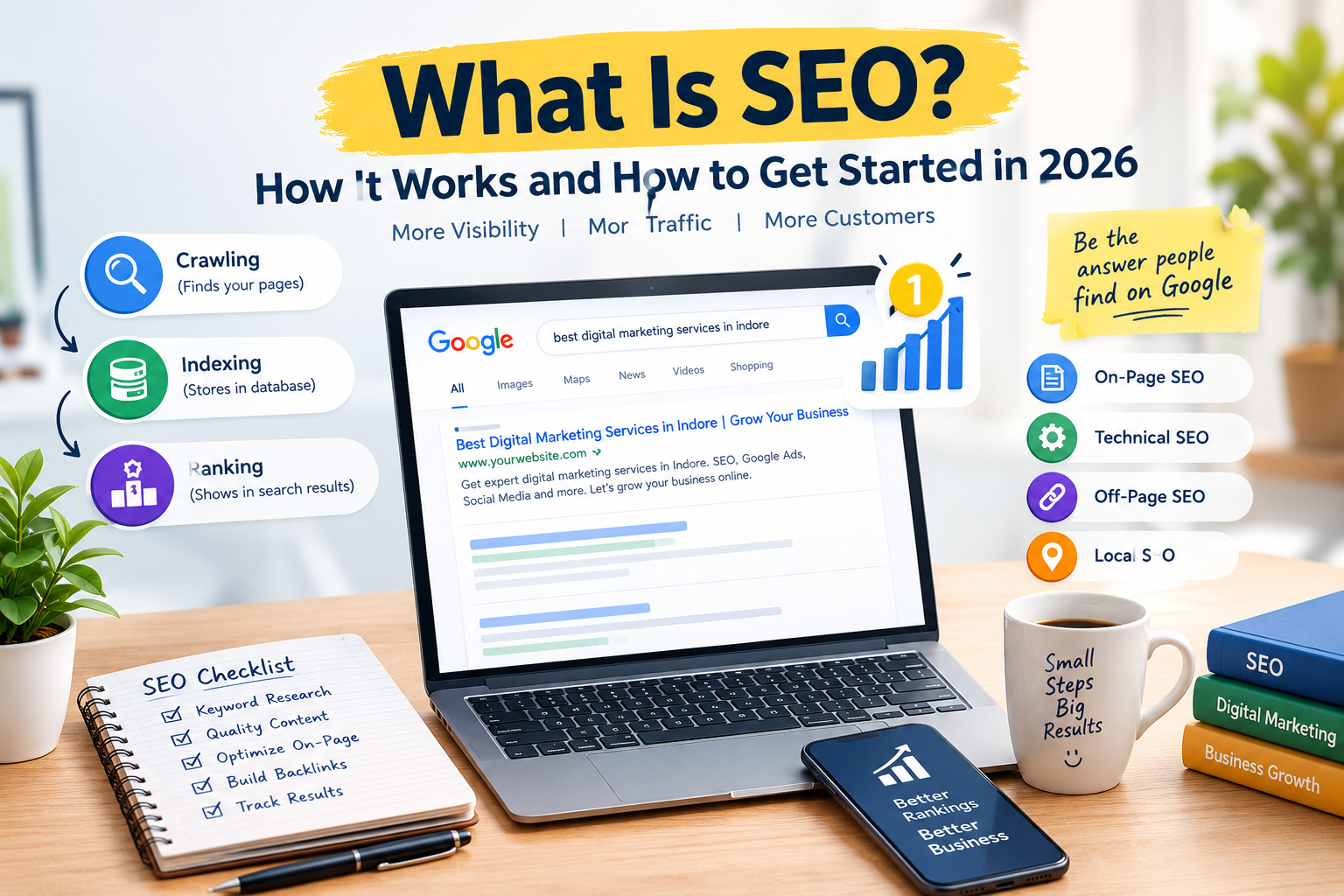
Think about the last time you wanted something nearby. You probably typed it into Google, looked at the first few results, and picked one. You almost never went to page two.
That is exactly why SEO matters. If your business doesn’t show up when people search, those customers go to someone else.
This guide explains what SEO is, how it works, its main types, and a simple plan to start, all in plain language. If you are new to online marketing, you may also like our digital marketing for beginners guide.
What Is SEO?
SEO stands for Search Engine Optimization. It is the process of improving your website and content so that search engines like Google show it higher when people search for things related to your business.
In simple words: SEO helps the right people find you on Google, without you paying for each click.
For example, if someone searches “web designer in Indore” and your website appears on the first page, that is SEO working for you.
Why Is SEO Important for Small Businesses?
- Your customers search first. Most people check Google before buying or visiting a new place.
- It brings free, long-term traffic. Once a page ranks, it can keep bringing visitors for months without paying per click.
- It builds trust. People tend to trust businesses that appear in search results.
- It reaches people who are already interested. Someone searching “birthday e-invite maker” already wants that service.
- It works day and night. Your website brings enquiries even when you are asleep.
- It is cost-effective over time. SEO takes effort and patience, but you do not pay Google every time someone clicks.
Compare this with offline promotion in our guide on digital marketing vs traditional marketing.
How Does SEO Work?
Search engines use automated programs to discover, store, and rank web pages. The process has three simple steps:
- Crawling: Google’s bots (called crawlers) travel across the internet, following links and finding pages.
- Indexing: Google reads each page and stores it in a giant database called the index. If your page is not indexed, it cannot appear in search results.
- Ranking: When someone searches, Google picks the pages from its index that best match the search and shows them in order.
Google does not publish its full ranking formula, but its own documents say it looks at things like how helpful the content is, how well it matches what the person wants, how fast and usable the page is, and whether other trusted sites link to it. Google’s official SEO Starter Guide is the best place to confirm the basics.
The key idea is simple: Google wants to show the most helpful answer to the person searching. SEO is about being that answer.
Understanding Search Intent
Before writing anything, you must understand why someone is searching. This is called search intent. There are four common types:
| Intent | What the person wants | Example search |
|---|---|---|
| Informational | To learn something | “what is SEO” |
| Navigational | To reach a specific site | “Creative Nest Digital” |
| Commercial | To compare options | “best SEO freelancer in Indore” |
| Transactional | To buy or hire now | “hire SEO expert Indore price” |
If someone searches “what is SEO” and your page only tries to sell, you will not rank well. Match the content to the intent.
Types of SEO
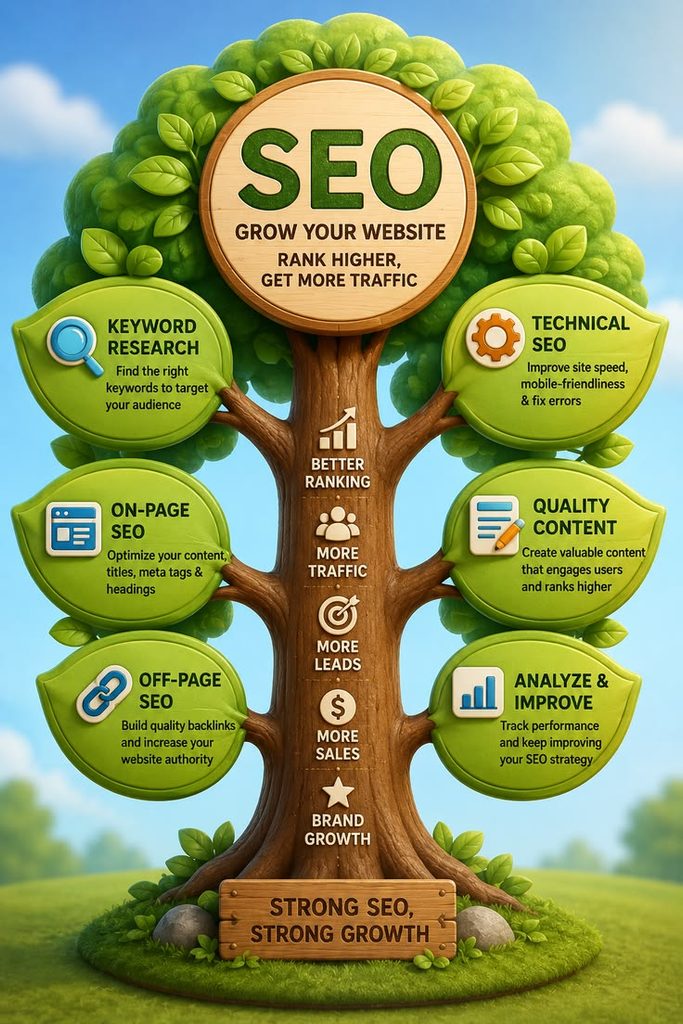
SEO has three main parts. Strong results come when all three work together.
1. On-Page SEO
These are the things you control on your pages:
- Using the right keyword in your title, headings, and first paragraph
- Writing helpful, original content
- Clear page titles and meta descriptions
- Short, clean URLs
- Image names and alt text
- Internal links to your other pages
2. Technical SEO
This is about how your website works behind the scenes:
- A fast-loading website
- A mobile-friendly design
- A secure website (HTTPS)
- A clean structure with no broken links
- A sitemap that helps Google find all your pages
3. Off-Page SEO
This is what happens outside your website:
- Backlinks (other trusted websites linking to you)
- Mentions of your brand online
- Reviews and local listings
- Social media presence
Backlinks work like recommendations. A link from a respected site tells Google your content is worth trusting. Quality matters far more than quantity.
Local SEO: Important for Local Businesses
If you serve customers in a specific city or area, local SEO helps you show up in “near me” searches and on Google Maps. The most important step is setting up a complete Google Business Profile with correct contact details, photos, and services, and collecting genuine reviews. Read more about how we help with local business marketing. [LINK: Local SEO Basics blog]
What Are Keywords?
Keywords are the words and phrases people type into Google. If you run a bakery in Indore, your customers might search:
- “cake shop in Indore”
- “birthday cake near me”
- “eggless cake order online”
Your job is to find the phrases your customers actually use and include them naturally in your content. Free tools like Google Keyword Planner and Google Trends can help. [LINK: Keyword Research blog]
Short-tail vs long-tail keywords:
- Short-tail: “cake” (very competitive, unclear intent)
- Long-tail: “eggless birthday cake in Indore” (less competitive, clearer intent)
For a new website, long-tail keywords are usually the best place to begin.
A 7-Step SEO Plan for Beginners
Step 1: Make a list of what you offer.
Write down your services and the problems you solve.
Step 2: Find your keywords.
Pick one main keyword for each page and a few related phrases. Don’t target the same keyword on many pages.
Step 3: Optimize each page.
Put your main keyword in the title, the first paragraph, one or two headings, and the URL. Write a clear meta description that makes people want to click. [LINK: On-Page SEO Checklist]
Step 4: Create helpful content regularly.
Blogs, guides, and FAQs that answer real customer questions help you rank for more searches. Write for people first, not for search engines.
Step 5: Fix your technical basics.
Make sure your site loads fast, looks good on mobile, and has no broken links.
Step 6: Get your Google Business Profile and listings right.
Keep your business name, address, and phone number the same everywhere.
Step 7: Track and improve.
Use Google Search Console to see which searches bring people to your site, and Google Analytics to see what they do after arriving. [LINK: Google Search Console blog]
How Long Does SEO Take?
SEO is not instant. A new website usually needs a few months to start seeing real movement, and the time depends on competition, your content quality, and how consistently you work on it. Anyone promising “#1 ranking in 7 days” should be treated with caution.
If you need leads quickly, paid ads can bring faster results while SEO builds up in the background. See our Google Ads & PPC service. [LINK: SEO vs Paid Ads blog]
Common SEO Mistakes to Avoid
- Keyword stuffing: repeating a keyword again and again makes content unreadable and can hurt you.
- Copying content: duplicate content adds no value.
- Ignoring mobile users: most searches in India happen on phones.
- Slow websites: large uncompressed images are a very common reason.
- Skipping meta titles and descriptions: these decide whether people click.
- No internal links: link your related pages so Google and readers can move around easily.
- Giving up too early: SEO rewards consistency.
- Buying cheap backlinks: low-quality links can do more harm than good.
SEO Myths, Busted
Myth 1: “SEO is a one-time job.”
It is ongoing. Competitors improve and Google updates its systems, so content needs regular updates.
Myth 2: “More keywords on a page means better ranking.”
Relevance and quality matter more than repetition.
Myth 3: “SEO is only for big companies.”
Small and local businesses can win by targeting specific local searches.
Myth 4: “Social media makes SEO unnecessary.”
Social media helps people discover you, but SEO helps people who are actively searching find you.
SEO Tools for Beginners (Free)
- Google Search Console: see your search performance and indexing problems
- Google Analytics: understand visitors and their behaviour
- Google Keyword Planner: keyword ideas and search volume
- Google Trends: see what is popular
- Google Business Profile: local search visibility
Final Thoughts
SEO is simply about helping people find you when they are already looking for what you offer. Start small: choose a few keywords, make your pages helpful and fast, set up your Google Business Profile, and publish useful content consistently.
It takes patience, but the traffic you build is free, steady, and trusted.
Want help getting your business found on Google? Creative Nest helps small businesses with SEO, websites, ads, and design. Book a free consultation →
Frequently Asked Questions
What is SEO in simple words?
SEO means improving your website so it appears higher on Google when people search for your products or services.
What does SEO stand for?
SEO stands for Search Engine Optimization.
How does SEO work?
Search engines crawl web pages, store them in an index, and then rank them based on how well they match what the person searched for and how helpful and trustworthy they are.
Is SEO free?
You do not pay Google for organic rankings, but SEO needs time, effort, and sometimes tools or professional help.
How long does SEO take to work?
Usually a few months for a new website, depending on competition and consistency.
What is the difference between SEO and Google Ads?
SEO brings free, long-term traffic but takes time. Google Ads brings quick traffic but stops when you stop paying. Many businesses use both.
Can I do SEO myself?
Yes. Basic SEO such as writing helpful content, using keywords properly, and setting up Google Business Profile can be done yourself. A professional can help with advanced technical work.
Do small businesses need SEO?
Yes, especially local businesses, because customers search on Google before they visit or buy.
What are the three types of SEO?
On-page SEO, technical SEO, and off-page SEO.
Leave a Reply