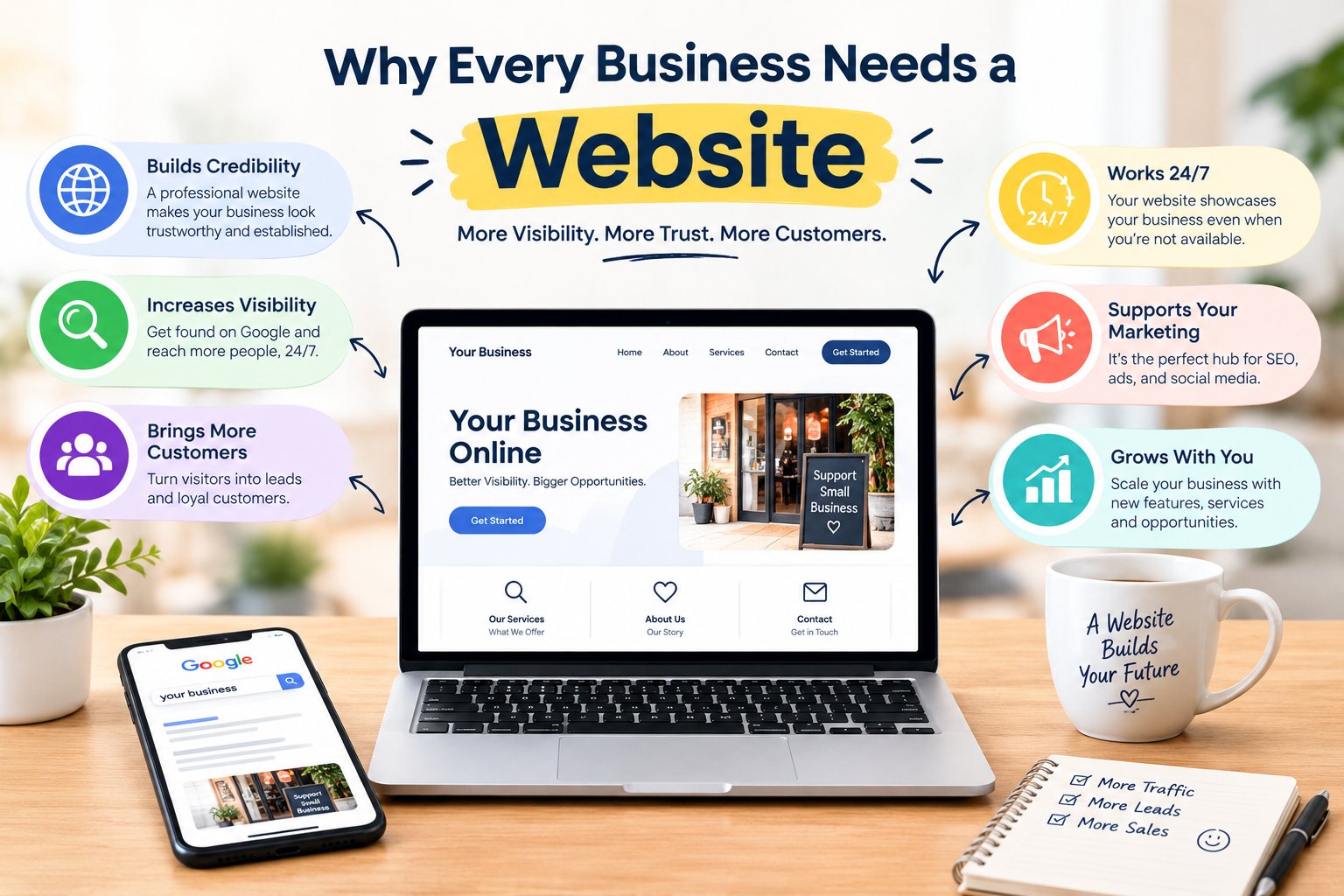
Why every business needs a website is a question many small business owners ask after they have already built a decent Instagram page. “I get enquiries on DM, I post regularly, people like my work. Why spend money on a website?”
It is a fair question, and Instagram is a great tool. But an Instagram page and a website do very different jobs. This guide explains the difference, what you risk by depending only on social media, and how even a simple website can bring you more trust and more customers.
If you are just starting out online, you may also want to read our digital marketing for beginners guide.
Instagram Page vs Website: What Is the Difference?
Think of it like this:
- Your Instagram page is rented space. You use it, but the platform owns it and decides the rules.
- Your website is your own shop. You decide how it looks, what it says, and what customers do there.
Both are useful, but only one of them is truly yours.
| Factor | Instagram Page | Your Own Website |
|---|---|---|
| Ownership | Platform owns it | You own it |
| Control over design | Limited to the app layout | Full control |
| Google search visibility | Limited | Can rank for many searches |
| Trust for new customers | Good for social proof | Strong for credibility |
| Detailed information | Hard to organise | Easy (services, pricing, FAQs) |
| Risk of losing reach or access | Algorithm changes or account issues | Very low |
| Lead collection | DMs and comments | Forms, WhatsApp buttons, bookings |
| Works while you sleep | Partly | Yes |
10 Reasons Why Every Business Needs a Website
1. You own it
Instagram can change how it shows your posts, change features, or even restrict an account. Your followers belong to the platform, not to you. A website is yours, and nobody can change its rules overnight.
2. It builds trust and credibility
Today, many people search for a business online before they call or visit. A professional website tells them you are serious and established. A business with only a social media page can feel less complete to some customers, especially for higher-value services like weddings, interiors, coaching, or consulting.
3. It helps people find you on Google
Instagram posts rarely show up when someone types a service into Google. A website can. If you build pages around what customers search for, such as “wedding e-invite designer in Indore,” you can appear in search results and get free visitors for months. Read what SEO is and how it works to understand how this works. Google’s own SEO Starter Guide is also a good official source.
4. It works 24 hours a day
Your website can answer questions, show your work, and collect enquiries at 2 a.m. while you are asleep. On Instagram, a potential customer may scroll away if they do not get an instant reply.
5. It gives you a home for all your information
Instagram bios are tiny. A website lets you clearly show:
- Your services and what is included
- Your portfolio and past work
- Customer reviews
- Your process and FAQs
- Contact details and location
This saves you from answering the same questions again and again in DMs.
6. It makes your ads work better
When you run ads, the click has to go somewhere. A focused website or landing page usually convert better than a social profile, because visitors see exactly what you offer and how to contact you. See our comparison of Google Ads vs Meta Ads to learn how each platform sends people to your business.
7. It supports your local visibility
If you serve a specific city, your website works together with your Google Business Profile. Google can read your website to understand what you do and where. Learn more in our guide to local SEO basics and set up a free Google Business Profile to appear on Google Maps.
8. It lets you collect leads and customers’ details
On Instagram, a follower is just a number. On a website, you can collect enquiry forms, phone numbers, and email addresses, and stay in touch through WhatsApp or email. These are contacts you can reach even if your reach on social media drops.
9. It gives you data
With a website, you can see how many people visit, which pages they open, and where they come from. Free tools like Google Search Console show which Google searches bring people to your site. This helps you make smarter decisions, instead of guessing.
10. It makes your marketing stronger overall
A website connects everything: your Instagram, your ads, your Google profile, and your offline marketing. Put your website link in your bio, on visiting cards, on your shop board, and in your WhatsApp catalogue. If you are still deciding between online and offline, read digital marketing vs traditional marketing.
“But I Already Get Customers From Instagram!”
That is great, and you should keep using it. This is not a choice between Instagram or a website. They work best together:
- Instagram helps people discover you, see your style, and follow your journey.
- Your website helps them trust you, learn the details, and take action.
A simple example: someone sees your reel, likes your work, and clicks your bio link. On your website, they find your services, reviews, and a “Get a Quote” button. That journey is much smoother than asking them to scroll through 200 posts.
What Happens If You Depend Only on Social Media?
- A sudden change in reach can reduce your enquiries
- If your account is hacked or restricted, you may lose your audience and content
- You cannot rank properly on Google
- Your branding looks the same as everyone else’s, because the layout is fixed
- Customers may find it hard to see your full services and prices
- You have no control over how your content is shown
This does not mean it will happen to you, but relying on one platform you do not own is a risk worth thinking about.
What Does a Good Business Website Need?
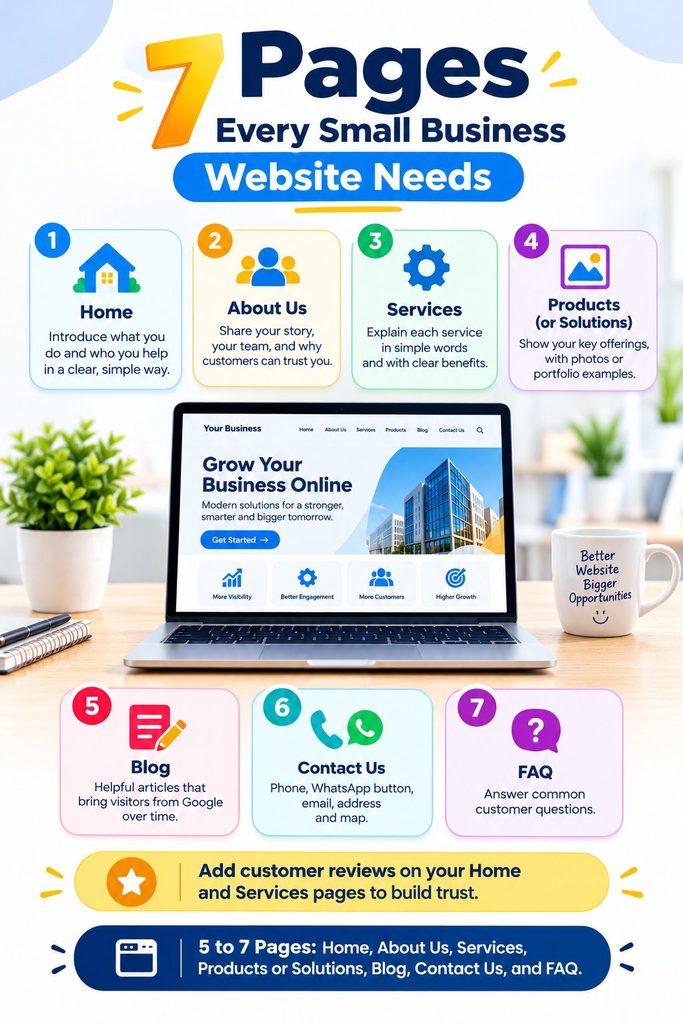
You do not need a huge website to start. A simple, clean one with these pages is enough for most small businesses:
- Home: a clear headline about what you do and who you help
- About: your story, your team, and why customers can trust you
- Services: each service explained simply
- Portfolio or gallery: proof of your work
- Testimonials or reviews: what customers say
- Contact: phone, WhatsApp button, email, address, and map
- Blog (optional but powerful): helps you rank on Google over time
Features That Matter Most
- Mobile-friendly design: most people visit websites from their phones
- Fast loading: slow sites make visitors leave. You can test yours for free with Google PageSpeed Insights
- Clear call-to-action buttons: like “Call Now,” “WhatsApp Us,” or “Get a Quote”
- Simple navigation: people should find things within a few taps
- Basic SEO setup: proper titles, descriptions, and headings
- Secure connection (HTTPS): builds trust and protects visitors
[LINK: Mobile-friendly aur fast website kaise banayein blog]
How Much Does a Website Cost?
The price depends on the type of website, the number of pages, the features, and who builds it. A simple business website costs much less than a large online store. Always compare what is included, such as design, mobile optimisation, basic SEO, and support, and not just the price. [LINK: Website banwane mein kitna kharcha aata hai blog]
You can also choose between platforms like WordPress, Wix, or a fully custom build. [LINK: WordPress vs Wix vs Custom blog]
Common Mistakes to Avoid
- Building a website with no clear purpose or call-to-action
- Using too much text, or too little useful information
- Using low-quality or stock photos only
- Not making the site mobile-friendly
- Forgetting to add your website link to Instagram, Google profile, and visiting cards
- Never updating the content
- Skipping basic SEO, so Google cannot understand the pages
- Choosing the cheapest option without checking quality
A Simple Plan to Get Started
Step 1: Decide the goal. Calls, WhatsApp enquiries, bookings, or online sales?
Step 2: Collect your content. Photos of your work, service details, reviews, and contact info.
Step 3: Choose the right type of website. A simple 5 to 6 page site is enough for most small businesses.
Step 4: Get it designed professionally. Clean design, easy navigation, and fast loading.
Step 5: Connect everything. Add the link to your Instagram bio, Google Business Profile, WhatsApp, and visiting cards.
Step 6: Add basic SEO. Set page titles, descriptions, and local keywords.
Step 7: Track and improve. Check your visitors and enquiries every month.
Final Thoughts
Instagram is wonderful for getting noticed, and every business should use it well. But a website is what turns attention into trust and trust into customers. It is the one online space you own, control, and can grow over time.
You do not need a huge, expensive website to begin. You need a clear, professional, mobile-friendly site that tells people who you are, what you offer, and how to reach you.
Ready to build your business website? Creative Nest designs clean, fast, mobile-friendly websites for small businesses, along with ads, SEO, and social media creatives. See our services or book a free consultation →
You can also read how we help with local business marketing.
Frequently Asked Questions
Why does every business need a website?
A website gives you ownership, credibility, Google visibility, and a place to share detailed information and collect leads, which a social media page alone cannot fully provide.
Is an Instagram page enough for a business?
It is a great start, but it is not enough on its own. It limits your design, your Google visibility, and your control, because the platform owns it.
Do small businesses really need a website?
Yes, especially if you want people to find and trust you online. Even a simple 5-page website can make a real difference.
Can I use both Instagram and a website?
Yes, and you should. Instagram helps people discover you, and your website helps them trust you and take action.
How many pages should a small business website have?
Most small businesses can start with 5 to 7 pages: Home, About, Services, Portfolio, Testimonials, and Contact.
Does a website help with Google search?
Yes. A website can rank for searches related to your services, and it works together with your Google Business Profile for local visibility.
How long does it take to build a business website?
It depends on the size and the content you provide. A simple business website can often be ready within a few weeks, once the content and photos are ready.
Can I build a website myself?
Yes, with tools like WordPress or Wix. But a professional designer can save you time and help you get a cleaner, faster, and more SEO-friendly result.
Leave a Reply