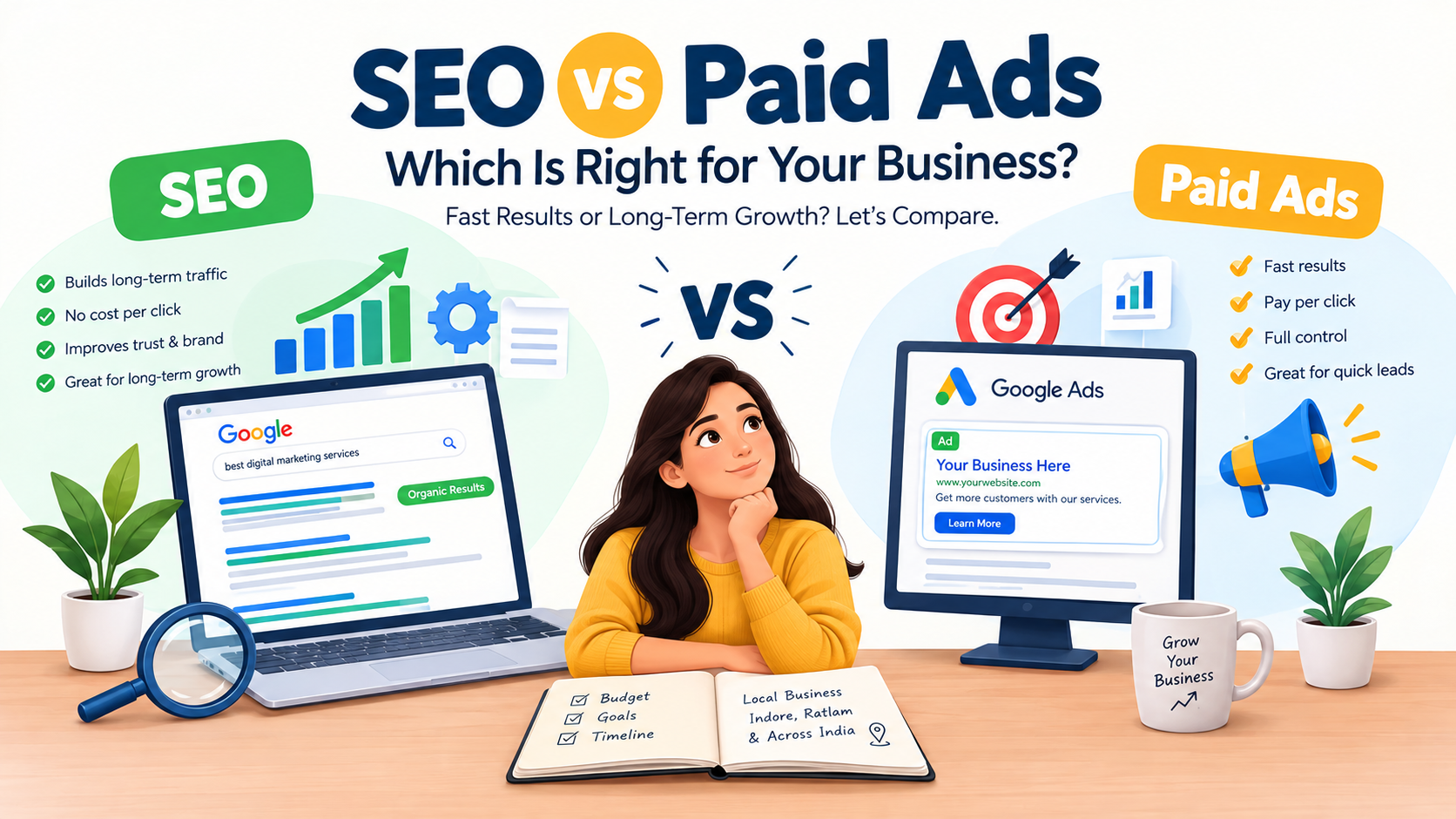
When people compare SEO vs. paid ads, the simple answer is this: paid ads give you fast results but stop when you stop paying, while SEO takes longer but builds steady, lasting traffic. If you need customers this month, start with paid ads. If you want steady customers for the long term, invest in SEO. For most small businesses, the best plan is a smart mix of both.
In this guide, you will learn what SEO and paid ads are, the 7 key differences between them, how to choose based on your budget and goals, and how to use both together. It is written for small business owners in Indore, Ratlam, and across India.
What Is SEO?
SEO stands for search engine optimization. It means improving your website and online presence so that your business appears higher in the normal (organic) results on Google, without paying for each click. If you are new to it, read our guide on what SEO is and how it works.
SEO includes writing helpful content, using the right keywords, making your website fast and easy to use, and getting your business details right online. You can read Google’s own advice in its SEO Starter Guide.
For businesses that serve a local area, local SEO helps you show up when people search for services near them.
What Are Paid Ads?
Paid ads are advertisements you pay for, so your business appears at the top of search results or in other places online. The most common type is Google Ads, where you usually pay each time someone clicks on your ad. This is called pay-per-click (PPC).
You choose your keywords, location, and budget, and your ad can start showing very quickly. To understand spending, read our guide on how much to spend on a Google Ads budget.
SEO vs Paid Ads: 7 Key Differences
Here is a quick SEO vs. paid ads comparison before we explain each point:
| Factor | SEO | Paid ads |
|---|---|---|
| Speed | Slow, usually takes months | Fast, can start within days |
| Cost | No cost per click, but needs time or money for content and work | You pay for every click. |
| How long it lasts | Keeps working for a long time | Stops when you stop paying |
| Trust | Often feels more trustworthy to searchers | Clearly marked as an ad |
| Control | Less control, as Google decides rankings | High control over keywords, budget, and location |
| Results certainty | No guarantee of rankings | Visibility is likely if you bid and budget properly. |
| Best for | Long-term growth | Quick leads and tests |
1. Speed
Paid ads can bring you visitors within days of launching a campaign. SEO usually takes several weeks to months before you see strong results, because Google needs time to understand and trust your website. This is the biggest difference between SEO and paid ads.
2. Cost
With SEO, you do not pay Google for each click, but it is not free. You spend time or money on writing content, improving your website, and sometimes hiring help. With paid ads, you pay for every click, so your cost grows as your traffic grows.
3. How Long the Results Last
A good blog or well-optimized page can bring visitors for months or years. Paid ad traffic stops as soon as you pause your campaign or your budget ends.
4. Trust and Clicks
Paid results are labelled as ads, and many people prefer to click on normal results because they feel more natural. Strong organic rankings, good reviews, and a helpful website can build trust over time.
5. Control
With paid ads, you decide exactly who sees your ad, where, and when. With SEO, you can improve your chances, but Google decides where you rank.
6. Certainty
No one can guarantee a first-page ranking in SEO, no matter what an agency promises. Be careful of anyone who says they can. With paid ads, you can show up quickly if your bid, budget, and ad quality are good, but you still need to pay.
7. Best Use
Paid ads work well for launches, offers, seasonal campaigns, and testing new services. SEO works well for building a lasting source of customers.
Pros and Cons of SEO
Pros of SEO:
- No cost per click
- Results can last for a long time
- Builds trust and brand authority
- Gets cheaper per customer over time
Cons of SEO:
- Takes time to show results
- No guaranteed rankings
- Needs regular content and updates
- Google’s rules and rankings can change
Pros and Cons of Paid Ads
Pros of paid ads:
- Fast results
- Precise targeting by location, keywords, and time
- Easy to measure and adjust
- Works well for new businesses with no website traffic yet
Cons of paid ads:
- You pay for every click
- Traffic stops when the budget stops
- Costs can rise with competition
- Poor setup can waste money quickly
SEO vs. Paid Ads for Local Businesses in India
If you run a local business in a city like Indore or Ratlam, there are special things to think about:
- Local searches matter a lot. People search for things like “salon near me” or “photographer in Indore.” Setting up your Google Business Profile is one of the best low-cost steps you can take.
- Competition may be smaller. In smaller cities, local SEO can bring results faster than in large metros.
- Phone calls and WhatsApp matter. Both SEO and ads should make it easy for people to call or message you.
- A good website helps both. Your business website is the place where SEO visitors and ad clicks turn into inquiries.
When SEO Is the Better Choice in the SEO vs. Paid Ads Debate
SEO is usually the better choice when you are building something for the long term. Choose SEO first if:
- Your service is something people search for all year, such as photography, tuition, repairs, or beauty services.
- You have a limited ad budget but can put in time to write helpful content.
- You want your website to keep bringing visitors without paying for every click.
- You are willing to wait a few months for stronger results.
When Paid Ads Are the Better Choice in the SEO vs. Paid Ads Debate
Paid ads are usually the better choice when time matters more than anything else. Choose ads first if:
- You are launching a new business, product, or offer and need visibility quickly.
- Your business depends on a season, such as Diwali sales, admissions, or wedding bookings.
- You want to test whether people are actually searching for your service.
- You already have a good website or landing page that can turn clicks into inquiries.
Two Real-Life Examples of SEO vs. Paid Ads
Example 1: A new coaching class in Indore. The owner needs students before the admission season ends in six weeks. SEO will not show results fast enough, so she starts with a small Google Ads campaign for specific searches like “IIT coaching in Indore” and slowly builds blog content and a Google Business Profile for long-term growth.
Example 2: A home bakery in Ratlam. The owner has a small budget and customers who search for “cake shop near me” all year. He sets up a Google Business Profile, collects reviews, builds a simple website, and posts local content. This low-cost local SEO approach brings steady orders over time, and he adds ads only before big festivals.
These two cases show that the answer to SEO vs. paid ads depends on your timeline and goal, not on one method being better for everyone.
How to Choose Between SEO vs. Paid Ads
Use this simple SEO vs. paid ads guide to decide where to start:
| Your situation | Better starting point |
|---|---|
| You need customers within a few weeks | Paid ads |
| You have a small budget and can wait a few months. | SEO |
| You are launching a new product or offer. | Paid ads |
| You want steady enquiries for years. | SEO |
| You have no website traffic yet. | Paid ads, along with starting SEO |
| You serve a local area. | Local SEO and a Google Business Profile, plus a small ad test |
| You want to test which services people want. | Paid ads |
The best way to settle SEO vs. paid ads is to think about three things: your timeline, your budget, and your goal. If you cannot wait, start with ads. If you can invest for the future, start SEO as early as possible, because it takes time to build.
Why Using Both Often Works Best
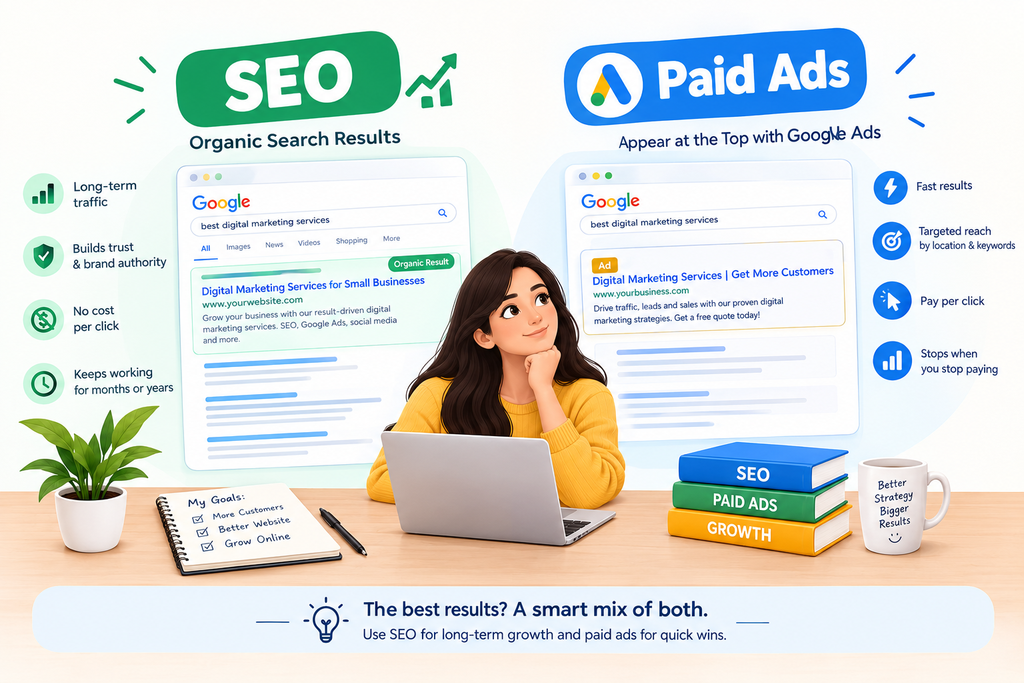
The real answer to SEO vs. paid ads is that they work well together:
- Ads give quick data. You can see which keywords bring clicks and inquiries, then write SEO content about those topics.
- SEO lowers your long-term costs. As your organic traffic grows, you can depend less on paid clicks.
- You show up twice. When your business appears in both ads and normal results, people see you more often and trust you more.
- Ads fill the gap while SEO grows. You get customers now while you build your long-term traffic.
A Simple 3-Month Plan Using SEO and Paid Ads
- Month 1: Set up. Create your Google Business Profile, fix your website basics, and start a small Google Ads test with one service and one city.
- Month 2: Learn and publish. Look at which search terms bring inquiries. Write blog posts and service pages for those topics.
- Month 3: Improve. Pause weak ads, increase the budget on what works, and keep publishing helpful content.
After three months of testing SEO vs. paid ads together, you will have both early customers and a growing base of organic content. Then you can decide how to divide your budget between SEO and paid ads.
Common Mistakes When Choosing Between SEO and Paid Ads
- Expecting SEO to work in a week. It needs patience and regular work.
- Running ads to a poor website. You waste money if your page is slow or confusing.
- Stopping SEO after a few weeks. Results often come after steady effort over time.
- Trusting guaranteed ranking promises. No one can control Google’s results.
- Not tracking results. Without data, you cannot tell what is working.
- Choosing only one forever. Your best mix may change as your business grows.
How to Measure SEO vs Paid Ads Results
Whatever you choose in SEO vs. paid ads, track your results. For SEO, use Google Search Console to see which searches bring people to your site. For paid ads, check your Google Ads reports for clicks, cost, and inquiries.
Look at these numbers:
- Enquiries: Calls, messages, and form submissions.
- Cost per inquiry: How much each inquiry costs you.
- Traffic sources: How many visitors come from organic and paid results.
- Customers gained: How many enquiries became sales.
Review these every month, and move your effort towards what brings the best results.
Where Social Media and Other Channels Fit In
SEO vs paid ads is only one part of marketing. Social media, referrals and offline promotion can also support your growth. If you are still deciding between online and offline marketing, read digital marketing vs traditional marketing. If you are deciding where to run paid ads, compare Google Ads vs Meta Ads.
New to everything? Start with our digital marketing for beginners guide to see how all these pieces fit together. You can also explore our Google Ads and PPC service and our local business marketing support.
Frequently Asked Questions About SEO vs Paid Ads
Is SEO better than paid ads?
In the SEO vs paid ads question, neither is always better. SEO is better for long-term, low-cost traffic, while paid ads are better for fast results. The right choice depends on your timeline and budget.
Can I use SEO and paid ads together?
Yes. Using both is often the best approach, because ads bring quick customers while SEO builds long-term traffic.
How long does SEO take to work?
It varies, but it usually takes several weeks to a few months to see clear results, and it depends on your competition and how consistently you work on it.
Is SEO free?
You do not pay Google for clicks, but SEO is not free. It takes time, effort and sometimes money for content, design and expert help.
Which is cheaper, SEO or paid ads?
Paid ads are cheaper to start but cost more as long as you keep running them. SEO often costs more effort at the start and can become cheaper per customer over time.
What should a small business in India start with?
A good starting point is to set up your Google Business Profile, build a simple website and run a small paid ads test while you start SEO. This gives you early results and long-term growth.
Conclusion
The choice between SEO vs paid ads is not about finding a winner. It is about choosing what fits your goal, your budget and your timeline. Use paid ads when you need quick customers, invest in SEO for lasting growth, and combine both when you can. Start small, track your results and improve step by step.
If you would like help deciding what is best for your business, we are here for you. Creative Nest helps small businesses with SEO, Google Ads, websites and digital marketing. Book a free consultation and let’s build a plan that fits your goals.
Leave a Reply