If you run a small business, freelance, or are planning to start something of your own, you’ve heard the term “digital marketing” again and again. Everyone says you need it, but very few people explain what it is, where to begin, or how much it costs.
This digital marketing for beginners guide answers all of that in plain language. By the end, you’ll understand how it works, the main types, how to build your first strategy, how to set a budget, which mistakes to avoid, and which free tools to use from day one.
What Is Digital Marketing?
Digital marketing is the practice of promoting a business, brand, product, or service using online channels such as search engines, social media, websites, email, messaging apps, and paid ads.
In simple words: wherever your customers spend time online, digital marketing helps you show up there with the right message at the right time.
A local bakery posting reels on Instagram, a coaching institute running Google ads, a designer sharing portfolio posts on LinkedIn, and a clothing store sending offers on WhatsApp are all examples of digital marketing. If you are new to this, it simply means learning how to reach customers online, one channel at a time.
How Does Digital Marketing Work?
The basics of digital marketing for beginners follow one simple loop:
- Attract: you create content, ads, or a web presence that gets people’s attention.
- Engage: people visit your profile or website, watch your content, and learn about you.
- Convert: they take an action, such as messaging you, filling a form, calling, or buying. This is how lead generation turns attention into real inquiries.
- Retain: you stay in touch through email, WhatsApp, or social media so they return and recommend you.
The real power is that every step can be tracked. You can see who saw your post, who clicked, who inquired, and which channel brought the customer. That is what makes digital marketing smarter than guessing.
Why Digital Marketing for Beginners Matters for Small Businesses
- Your customers are already online. Before buying, most people search on Google, check Instagram, or read reviews.
- It’s affordable. You can start with almost no money using organic content and add a small ad budget later.
- It’s measurable. You know what’s working and what’s wasting money.
- It levels the playing field. A small business with a great Instagram page can compete with a bigger brand.
- It builds trust. A professional website, good reviews, and consistent posting make you look reliable.
- It works around the clock. Your website and content bring in enquiries even when your shop is closed.
- You can target precisely. Ads can be shown by location, age, interests, and behavior, so you don’t waste money on the wrong people.
That is why digital marketing for beginners is one of the best skills a small business owner can learn today.
Wondering how it compares with print ads and hoardings? See which marketing is better for your business, online or offline.
Digital Marketing vs. Traditional Marketing
| | Traditional Marketing | Digital Marketing |
|---|---|---|
| Examples | Newspaper ads, hoardings, pamphlets, radio | Social media, Google, email, online ads |
| Cost | Usually high, with a fixed price | Flexible, can start small |
| Targeting | Broad, reaches everyone | Specific, by location, age, and interest |
| Tracking | Hard to measure | Detailed, real-time data |
| Interaction | One-way | Two-way (comments, DMs, replies) |
| Speed of change | Slow | Instant edits and improvements |
For most small businesses, digital marketing for beginners is a faster and cheaper starting point than print or hoardings. Both approaches have their place, though. A local shop can still benefit from a board outside. Read our full breakdown of digital marketing vs. traditional marketing to see the cost, reach and ROI comparison in detail.
Types of Digital Marketing
Any good digital marketing for beginners’ plan starts with knowing the main channels, so you can decide where to put your time and money first. Here are the nine you will hear about most.
1. Social Media Marketing
This means using platforms like Instagram, Facebook, LinkedIn, YouTube, and X to share content, talk to customers, and build a community. Learn more in our guide to social media marketing and Instagram marketing for small businesses.
Tips for beginners:
- Pick one or two platforms where your customers actually are.
- Mix content types: reels, carousels, stories, and simple posts.
- Reply to every comment and message. It builds trust quickly.
- Use a clear profile photo, bio, and contact button.
2. Search Engine Optimization (SEO)
SEO is the process of improving your website so it appears higher on Google when people search for what you offer. If someone searches “web designer in Indore” and your website appears, that’s SEO working for you. Our guide on what SEO is and how it works covers it in depth, and Google’s own SEO Starter Guide is a great official reference.
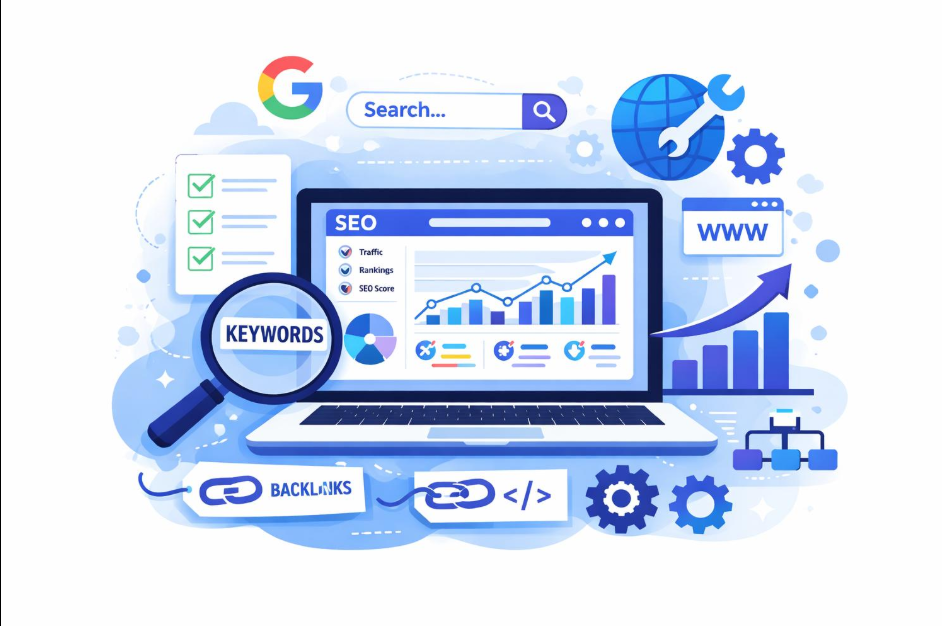
SEO has three parts:
- On-page SEO: keywords, titles, headings, and helpful content on your pages.
- Technical SEO: site speed, mobile-friendliness, and a clean website structure.
- Off-page SEO: backlinks and mentions from other trusted websites.
SEO takes time, usually a few months, but the traffic it brings is free and long-lasting.
3. Content Marketing
Content marketing means creating useful content such as blogs, videos, reels, guides, and checklists that answer your customers’ questions. Instead of directly selling, you educate. When people learn from you, they trust you, and trust leads to sales. See what content marketing is for a deeper look.
A blog like this one is content marketing. It attracts people searching for answers, and some of them become customers.
4. Paid Advertising (PPC and Social Ads)
With paid ads, you pay to show your message to a chosen audience. Popular options are Google Ads, Instagram and Facebook ads, and YouTube ads. Not sure which to pick? Compare Google Ads vs. Meta Ads.
- Why it’s useful: results come fast. You can start getting enquiries within days.
- Watch out for: without proper targeting and tracking, beginners can waste money quickly. Always start with a small test budget.
5. Email Marketing
Email marketing is sending offers, updates, and helpful tips to people who have given you their email address. It is one of the most cost-effective ways to bring back past customers and keep your audience warm.
6. WhatsApp and Messaging Marketing
For many businesses in India, WhatsApp is where customers actually talk. Using WhatsApp Business, you can create a catalogue, set quick replies, share offers with people who have opted in, and answer questions instantly. Always get permission before sending promotional messages.
7. Local SEO and Google Business Profile
If you serve customers in a specific city or area, a complete Google Business Profile helps you appear in local searches and on Google Maps. Add correct contact details, timings, photos, and services, and collect genuine customer reviews. Start with our local SEO basics and the Google Business Profile beginner’s guide.
8. Affiliate and Influencer Marketing
Here you partner with creators or other people who promote your product and get a commission or a fee. For a beginner, working with small local creators can be more affordable and more trusted than big influencers.
9. Video Marketing
Short reels, YouTube videos, and explainers are among the most engaging types of content today. You don’t need expensive equipment. A phone, good lighting, and a clear message are enough to start.
Understanding the Marketing Funnel
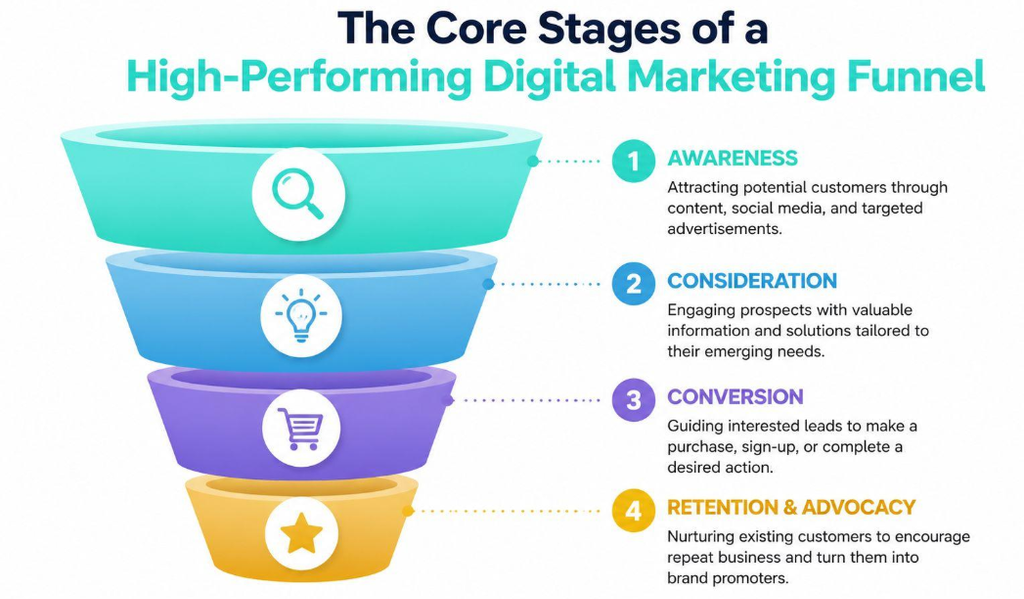
Understanding the funnel makes digital marketing for beginners much easier, because it shows what content to create at each stage. It explains the journey a customer takes before buying. For a full walkthrough, read our digital marketing funnel explained guide.
- Awareness (top): the person discovers you through a reel, a Google search, or an ad. Use reels, blogs, SEO, and social ads.
- Consideration (middle): they compare you with others and look for proof. Use case studies, reviews, portfolios, FAQs, and free guides.
- Conversion (bottom): they decide to contact or buy. Use clear offers, easy contact options, a WhatsApp button, and limited-time deals.
- Loyalty (after): they return and recommend you. Use email, WhatsApp updates, referral offers, and good service.
Many beginners only focus on awareness and wonder why sales don’t come. Make sure your content supports every stage.
A 7-Step Plan for Digital Marketing for Beginners
Follow this digital marketing for beginners plan step by step, and don’t skip the goal-setting part. If you want to go deeper later, here is how to create a full digital marketing strategy.
Step 1: Set One Clear Goal
Decide what you want most right now: more followers, more website visitors, more inquiries, or more sales. Make it specific, such as “get 20 inquiries per month.”
Step 2: Know Your Target Audience
Write down who your ideal customer is: their age, city, problems, budget, and where they spend time online. The more specific you are, the better your content and ads perform.
Step 3: Study Your Competitors
Look at 3 to 5 similar businesses. What do they post? Which content gets attention? What are customers saying in the comments? Learn from them, but don’t copy.
Step 4: Build Your Online Base
You need a home base:
- A simple, fast, mobile-friendly website with your services and contact details (see why every business needs a website)
- One or two social media profiles with a consistent look
- A Google Business Profile if you serve local customers
- A WhatsApp Business account for quick customer chats
Step 5: Create Helpful Content Consistently
You don’t need to post daily. Posting three to four times a week regularly works better than posting a lot and disappearing. Use a mix of educational posts, behind-the-scenes, customer proof, and offers. A monthly content calendar makes this much easier, and you can check how often to post on Instagram for guidance.
Step 6: Promote Your Content
Organic reach is limited, especially at the start. Share your content in relevant groups, ask friends and clients to engage, and use a small ad budget to push your best-performing posts.
Step 7: Track, Learn, and Improve
Review your numbers every week. Which posts got the most reach? Which ad brought inquiries? Do more of what works and stop what doesn’t.
Want help putting this plan into action?
Creative Nest helps small businesses with digital marketing, ads, websites, e-invites, and design. Tell us what you need, and we’ll guide you on the best next step.
Book a Consultation →
Your First 30 Days: A Simple Action Plan
Use this 30-day plan as your digital marketing for beginners checklist. For a bigger version, see our digital marketing checklist for small businesses.
Week 1: Foundation
- Define your goal and target audience
- Set up or clean up your website and social profiles
- Create your Google Business Profile
- Plan a simple content calendar
Week 2: Start Creating
- Post 3 to 4 times this week (mix reels, carousels, and simple posts)
- Publish your first blog post
- Reply to every comment and message
Week 3: Grow and Engage
- Follow and interact with your target audience and local businesses
- Collect your first reviews and testimonials
- Share your blog on social media
- Try a small test ad with a low daily budget
Week 4: Review and Improve
- Check which content performed best
- Note what your audience liked and what they ignored
- Plan next month’s content around your best performers
- Adjust your goal if needed
How Much Should You Spend on Digital Marketing?
There is no fixed number, but here is a beginner-friendly way to think about it:
- ₹0 budget: organic social media, blogging, Google Business Profile, WhatsApp Business. It needs time and consistency, but it’s free.
- Small budget: add a small daily ad budget to test what works. Many beginners start with around ₹300 to ₹500 per day for a week or two, and keep it low until they see results.
- Growing budget: once you know which ad or channel brings customers, increase spending slowly on that.
Golden rule: test small, learn fast, and scale only what works. Never put a large amount into ads before you’ve tested your offer and audience. For more detail, read how much digital marketing costs for a small business and how much to spend on Google Ads. To see how this compares with the upfront cost of print and hoardings, check our online vs offline marketing cost comparison.
Key Metrics Every Beginner Should Track
When learning digital marketing for beginners, track only a few numbers at first. Start with these:
- Reach and impressions: how many people saw your content
- Engagement rate: likes, comments, shares, and saves compared to reach
- Website traffic: how many people visit your website and from where (free in Google Analytics)
- Click-through rate (CTR): how many people clicked after seeing your ad or link. See what a good ad CTR looks like.
- Leads or enquiries: how many people contacted you
- Conversion rate: what percentage of visitors or leads became customers. Here is why conversion rate matters.
- Cost per lead (CPL): how much you spent to get one enquiry
Followers and likes look good, but enquiries and sales are what grow your business.
Common Digital Marketing Mistakes to Avoid
Most digital marketing for beginners mistakes come from doing too much, too early.
- Trying to be on every platform at once
- Posting randomly without a plan or goal
- Ignoring comments, DMs, and reviews
- Expecting overnight results (see how long digital marketing takes to show results)
- Running ads without clear targeting or tracking
- Only posting promotions and never giving value
- Having a website that is slow or not mobile-friendly
- Copying competitors instead of building your own identity
- Never checking analytics
- Giving up too early
Want the complete list? Read common digital marketing mistakes small businesses make.
Digital Marketing Myths, Busted
Myth 1: “You need a huge budget.”
Not true. Many businesses start with organic content and grow step by step.
Myth 2: “More followers means more sales.”
Followers help, but the right audience and a clear offer matter far more.
Myth 3: “SEO is a one-time job.”
SEO is ongoing. Google changes, competitors improve, and content needs updating.
Myth 4: “Digital marketing works instantly.”
Ads can be quick, but building trust, reach, and rankings takes consistent effort.
Myth 5: “Only big brands need it.”
Small and local businesses often benefit the most because they can reach nearby customers cheaply.
Free Tools to Get Started
You don’t need expensive software to start. These free tools cover almost everything:
- Canva: design posts, reel covers, banners, and presentations (new to it? try our Canva for beginners guide)
- Google Analytics: understand your website visitors and behaviour
- Google Search Console: see how your website performs in Google search
- Google Business Profile: appear in local searches and Google Maps
- Meta Business Suite: schedule posts and manage Facebook and Instagram ads
- Google Keyword Planner: find out what people search for (needs a free Google Ads account)
- WhatsApp Business: catalogue, quick replies, and customer chats
- Google Trends: see what topics are popular right now
- CapCut: simple video editing for reels
Skills You Need to Learn Digital Marketing
The good news is that digital marketing for beginners needs practice more than a degree. These skills help a lot:
- Basic writing: clear captions, headlines, and ad copy
- Design sense: using tools like Canva to make clean visuals
- Understanding people: knowing what your audience wants and fears
- Analytics: reading simple numbers and making decisions
- Consistency and patience: the most underrated skill of all
Start by learning one skill at a time and practising on a real page or project. Hands-on practice teaches faster than only watching tutorials. For free official training, explore Google Skillshop and Grow with Google certificates. If you are thinking of this as a career, read how to start a career in digital marketing and the skills you need in 2026.
Frequently Asked Questions
What is digital marketing in simple words?
Digital marketing means promoting your business online through channels like Google, social media, email, and ads so that more people find you and become customers.
Is digital marketing for beginners difficult to learn?
Not at all. Digital marketing for beginners is easy to start if you learn one channel at a time and practise on a real page.
Can a beginner learn digital marketing without a degree?
Yes. It is a practical skill. With free tools, online resources, and real practice, beginners can learn the basics in a few months.
How much money do I need to start digital marketing?
You can start almost free with organic social media, SEO, and content. Paid ads can begin with a small daily budget that you increase once you see results.
Which type of digital marketing is best for small businesses?
Social media marketing, local SEO with Google Business Profile, and WhatsApp marketing are usually the best starting points because they are low-cost and reach nearby customers.
How long does digital marketing take to show results?
Paid ads can bring results within days. SEO and content marketing usually take a few months to build momentum.
Do I need a website for digital marketing?
It’s strongly recommended. Social media is great, but a website gives you credibility, control, and a place to show your services, reviews, and contact details.
How often should I post on social media?
Three to four times a week is a good start for beginners. Consistency matters more than volume.
Should I do digital marketing myself or hire an agency?
If your budget is tight, start yourself to learn the basics. As you grow and time becomes limited, hiring a professional or agency saves time and avoids costly mistakes. If you’d like guidance, you can book a consultation with Creative Nest.
What is the difference between SEO and paid ads?
SEO brings free, long-term traffic but takes time. Paid ads bring quick traffic but stop when you stop paying. The best strategy often uses both. Here is a deeper look at SEO vs paid advertising.
Final Thoughts
Digital marketing for beginners is about starting small, staying consistent, tracking your results, and improving step by step. Pick one or two channels, create genuinely helpful content, talk to your audience, and be patient.
Every big brand you see online started with a first post. The businesses that win are the ones that keep showing up.
Need help with digital marketing for beginners or your online presence?
Creative Nest helps businesses with digital marketing, ads, websites, e-invites, and design. Reach out today and let’s grow your business together.
Book a Consultation→
Leave a Reply